CARE STARTS IN THE VEHICLE.
Ambulances, EMS supervisor and fly cars, mobile clinics and medical transport vans. Technology placed so crews can reach it, patients stay safe and the vehicle is ready for the next call.
From the first-due unit to the clinic on wheels.
Ambulances
The technology in and around the patient module and the cab: warning and scene lighting, radios, mobile data, cameras, power and shore power, equipment mounts and graphics. We work with the module builder's design, not against it.
Supervisor + fly cars
EMS supervisor, QRV and rapid-response SUVs and pickups set up to carry gear, communicate across the system and work a scene until units arrive.
Mobile medical + clinics
Mobile clinics, outreach and screening vans, and non-emergency medical transport vehicles that need power, connectivity, storage and clear identification.
Two workspaces, one vehicle.
An ambulance has a driver's workspace and a patient-care workspace. Both need power, communications and visibility, and the systems connecting them have to stay out of the way of care.
- 1Warning + scene lighting
- 2Module power + shore power
- 3Monitor + equipment mounts
- 4Cab radio + data
- 5Reflective striping
Built around the patient and the crew.
EMS vehicles run long hours, sit on shore power between calls and get cleaned constantly. Those realities shape every placement decision.
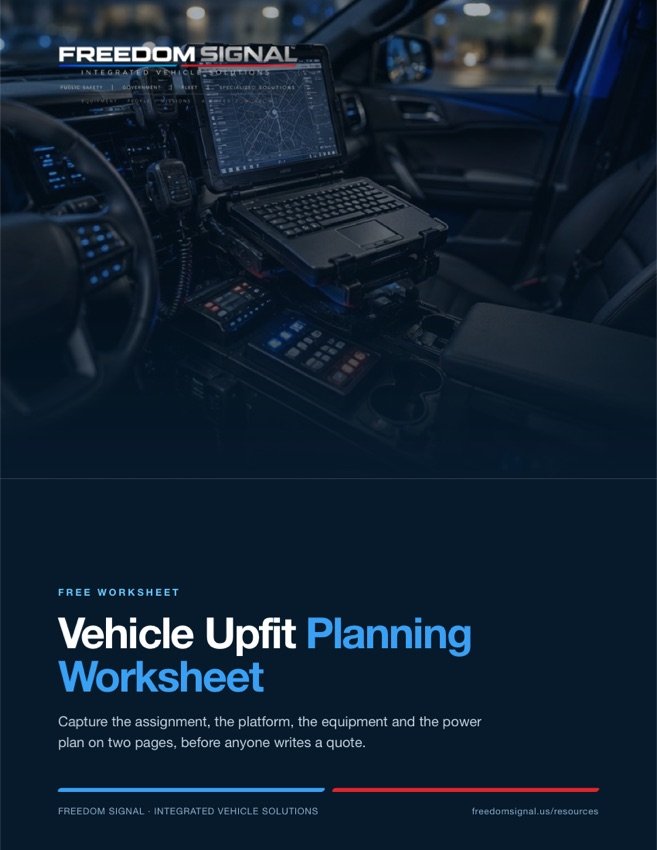
Vehicle Upfit Planning Worksheet
Capture the assignment, platform, equipment and power needs before the first quote.
- Power between calls. Shore power, chargers and battery protection keep equipment charged and the module conditioned while the unit waits.
- Mounts that hold. Monitors, devices and bags need secure mounting points that work with the module's structure.
- Easy to clean. Equipment and cable runs in care areas should be sealed, smooth and out of the way of decontamination.
- Talking to the hospital. Radio, cellular and data paths for dispatch, medical control and patient reporting.
- Scene and loading light. Lighting at the rear doors and around the vehicle for loading at night.
- Two operators. Controls for the driver up front and the attendant in back, without duplicating clutter.
Where EMS builds start.
Power + Equipment
Shore power, inverters, chargers, battery protection and secure equipment mounts.
Explore → 01Warning + Scene Lighting
Warning, intersection and loading lighting planned around the module and the cab.
Explore → 02Communications
Radio and cellular connectivity for dispatch, medical control and the receiving facility.
Explore → 03Mobile Data
Tablets and docks for patient care reporting, in the cab and in the module.
Explore → 04Video + Awareness
Backup and side cameras for large units, and cab and module views where policy calls for them.
Explore → 06Graphics + Striping
Reflective striping, chevrons, agency identification and unit numbers.
Explore →